

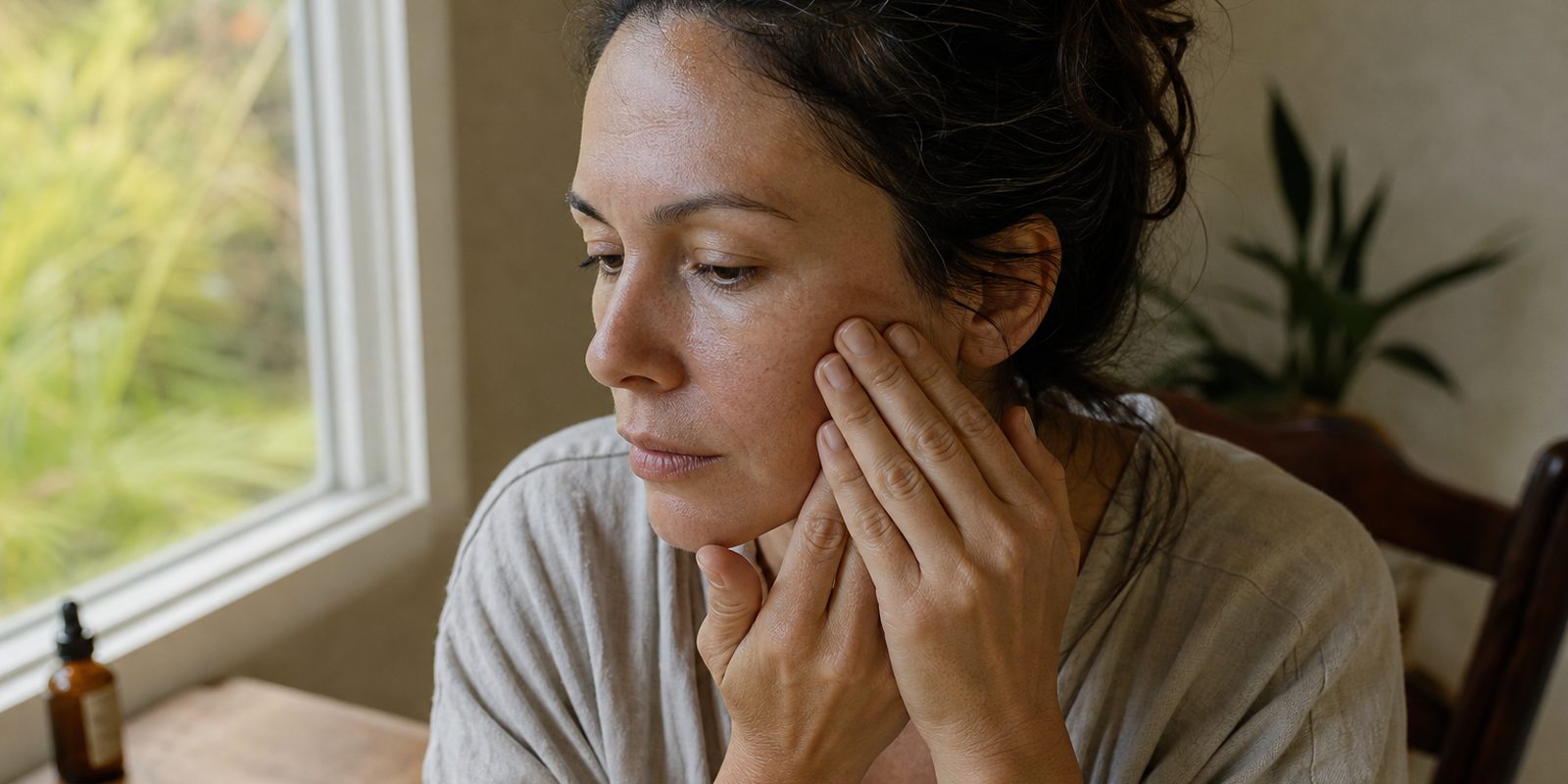
You catch yourself mid-clench at a red light. Or you wake up with a tired jaw, like it worked a night shift. Sometimes there is a click when you open, or a dull ache at the temple by mid-afternoon.
In this guide
This is a simple guide on how to massage masseter at home: how to find the chewing muscle, one starter you can do today, and when to take your hands off. It is self-care education, not a diagnosis, and it will not fix TMJ or TMJD.
Educational self-massage only. This is not a substitute for medical or dental care. Stop if pain increases. See a qualified clinician for persistent jaw, ear, or head pain, locking, or anything you cannot explain. Read the medical disclaimer.
What the masseter actually is
The masseter is a short, thick chewing muscle. It runs from the cheekbone down to the angle of the jaw. Its job is simple: close the mouth. Every chew, every talk, every unnoticed grind runs through it.
How to find it (clench test)
Place two fingertips on each cheek, about halfway between the cheekbone and the angle of the jaw.
Gently bite down, like you are closing your teeth together. Feel for a bulge under your fingers. That bulge is the masseter.
Unclench and feel it soften.
Do both sides. One side often feels tighter or more tender than the other. That is common. It is not a diagnosis.
Stay off the jaw joint
The hinge just in front of your ear is the jaw joint (TMJ). It is not a muscle, and it is not what you are working here. If you press right in front of the ear canal and feel sharpness, a pop, or joint pain, move your fingers forward onto the cheek bulge. Stay on muscle.
Why this muscle stays tight
A tight jaw is often part of a loop, not a one-off knot. When the day feels like a threat, the nervous system can shift into a low-grade fight-or-flight state. Clenching is an old bracing habit. Tighter chewing muscles then make it easier to clench again.
That same tightness can refer ache into the temple, ear, or teeth, so the cheek is not always where it feels loudest.
Hands on the muscle can help it soften. They do not turn off the stress response that keeps re-tightening it. Before you start, take one slow breath.
Before you put hands on your face
This is for your body. You do not have to finish anything. If a spot asks you to stop, stop.
Start gently. Light pressure first. Increase only if the tissue allows it.
Aim for dull, achy pressure you can stay with. Not sharp. Not electrical. Not “seeing stars.”
Sit or lie down with your head supported, so your neck is not bracing while your hands are on your jaw.
Hydrate before and after if you can. Hands are enough. No tools required. Optional warmth (a warm cloth or heat pack) is fine if it feels good.
Skip this, and see a dentist, PT, or physician instead, if:
You have an acute jaw injury, bruise, cut, or recent trauma to the area
You have an active infection (dental, sinus, or skin) near the jaw
You have had recent dental work, oral surgery, or extractions that have not fully healed
You notice unexplained swelling, numbness, a new lump, or pain that is getting worse
Do not push through those. This is not the week for self-massage.
Masseter self massage: one starter
You do not need five techniques on day one. You need one, done well.
Find the masseter with the clench test, then let the jaw hang loose. Mouth closed, not clenched, not stretched open.
Rest two or three fingertips flat on the bulge. Stay off the joint.
Make small, slow circles, about the size of a coin. Let the skin move with your fingers. Do not drag across it.
Keep going for about 30 to 60 seconds, then check in. If the tenderness has eased, repeat on the other side. If a spot is sharply painful rather than dully sore, lighten up or skip it today.
That is the whole starter. A few minutes most days beats one long grind session. Once a day is enough while you are learning how your jaw responds.
If you want guided work on this muscle, Release Your Jaw is the full class. $247, lifetime access.
What this can and cannot do
Gentle, consistent work can help a braced jaw feel a little less braced. That is it.
It will not replace a night guard if your dentist has recommended one. It will not stop nighttime grinding on its own. Massage and a guard solve different problems. Keep the guard.
It will not diagnose or treat TMJ or TMJD. If you already have a TMJ diagnosis, treat this as general self-care education. For plain-language medical background, start with the NIDCR page on TMD.
On headaches: some people notice that easing this muscle takes a little pressure off a temple ache, because the masseter can refer upward. That is a gentle thing to explore. It is not a migraine treatment. Persistent headaches need a proper evaluation. We will go deeper later in a piece on tension headaches and the jaw.
See a clinician, not a search engine, if you notice: a jaw that locks open or closed, swelling you cannot explain, numbness or tingling, new dizziness, or pain that is getting worse.
Common questions
How do I find my masseter muscle?
Two fingers on the cheek, halfway between cheekbone and jaw angle. Bite down gently. The bulge is the masseter. Unclench and it should soften.
How hard should I press when I massage my jaw?
Dull and achy is right. Sharp, radiating, or electrical means lighten up or stop.
How often should I massage my masseter?
Once a day is plenty while you are learning. More is not better.
Should I massage with my mouth open or closed?
Closed and relaxed. Jaw hanging loose. Not clenched. Not cranked open.
Can I massage the TMJ joint itself?
Not from this article. The joint is a different structure with different rules. Stay on the masseter bulge.
Is intraoral massage safe to do at home?
Inside-the-mouth work can be part of a full jaw routine. It also has hygiene and stop rules that do not fit a short how-to. Brooke walks that in class.
Do I need gloves for intraoral massage?
If you ever do that work, clean hands (and often a glove) matter. We are not giving those steps in this post.
Can massage replace a night guard for grinding?
No. Keep the guard your dentist gave you. Massage is not a substitute.
Can masseter massage help tension headaches?
Sometimes a little, around the temple. It is not a cure. See the section above.
When should I see a dentist or PT instead?
Locking, unexplained swelling, numbness, worsening pain, new dizziness, or anything on the skip list. Do not wait those out.
Work with Brooke
The clench test and one starter are a place to begin. If you want Brooke in your ear for breath, the full external sequence, and intra-oral work, Release Your Jaw is $247 once.
Brooke Neborsky, LMT
Brooke Neborsky, LMT, built Release Your Jaw for people who want guided work, not more guessing. It is $247 once, lifetime access: breath and the clench cycle (Lesson 1), the full external jaw sequence (Lesson 7), intra-oral work including the pterygoids (Lesson 8), what to do the morning the jaw wakes up angry (Lesson 12), and 7 daily routines.
Educational content only. This is not a substitute for medical or dental care. Read the medical disclaimer before you start.