

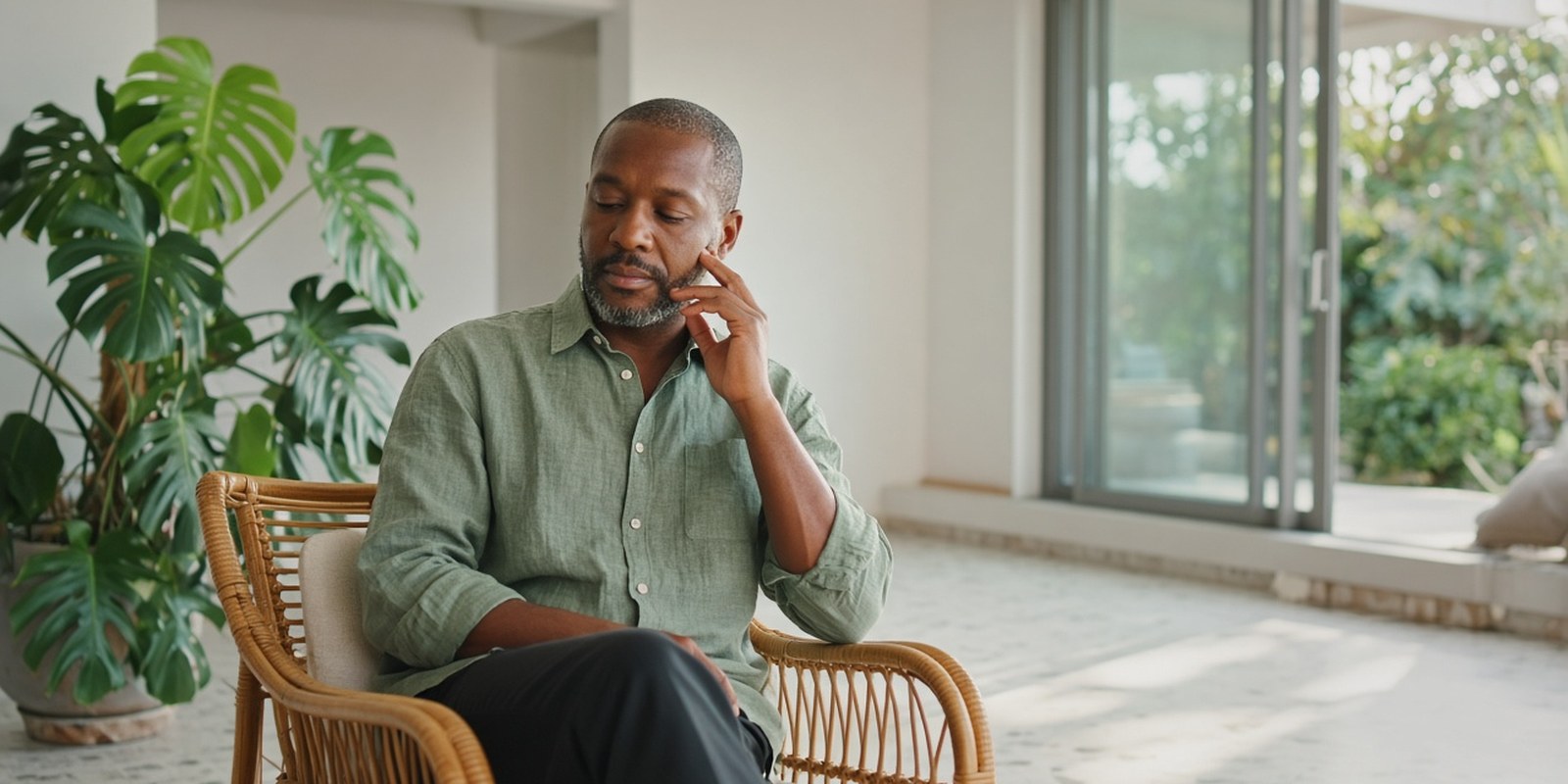
One cheek aches and the other feels fine. Chewing feels lopsided, or there is a dull ache under one cheekbone that you keep touching without meaning to.
Jaw pain on one side deserves a careful look before anyone reaches for massage. A tooth, the gums, the jaw joint, the ear, the sinuses, or a nerve can all show up as pain on one side of the jaw. So can a tired chewing muscle. This guide covers the signs that need care first, how everyday habits can load one side, and one gentle place to start once a clinician has the bigger picture. It is self-care education, not a diagnosis.
Educational self-massage only. This is not a substitute for medical or dental care. Stop if pain increases. See a qualified clinician for persistent jaw, ear, tooth, or head pain, locking, numbness, swelling, or anything you cannot explain. Read the medical disclaimer.
In this guide
Check this first: when jaw pain needs care now
Most one-sided jaw aches are not emergencies. A few are, and they come first for a reason.
Call emergency services right away if jaw pain comes with any of these:
- Chest pressure, tightness, or pain, or pain that spreads to the arm, shoulder, neck, or back
- Shortness of breath, cold sweat, nausea, or feeling faint
- Sudden facial drooping, weakness or numbness on one side of the body, slurred speech, or vision change
- A sudden, severe headache unlike any you have had
Do not wait those out, and do not try to massage them away.
Get seen the same day for jaw or facial swelling with fever, trouble swallowing or opening your mouth, or pain after a fall or a hit to the face.
When to see a dentist or doctor
Plenty of one-sided jaw pain is not urgent but still belongs with a clinician first. See your dentist if:
- One tooth hurts when you bite, chew, or drink something hot or cold
- Your gums are swollen, bleeding, or sore on that side
- Your bite feels different, or your teeth no longer meet the way they used to
- The jaw clicks painfully, catches, locks, or will not open fully
- You have had dental work on that side and the ache has not settled
See your doctor if the pain comes with ear pain, hearing changes, or ringing, sinus pressure, numbness or tingling in the face, a new lump in the jaw or neck, or pain that keeps getting worse. If one side of your jaw clicks or feels full near the ear, our posts on jaw clicking and popping and ear fullness and the jaw explain what is safe to try and when to get checked.
If your dentist has given you a night guard, keep wearing it. Massage does not replace it. For calm, plain-language background on jaw joint and muscle problems, the NIDCR page on TMD is a good place to start.
Why a jaw muscle can get sore on one side
You have two main chewing muscles on each side. The masseter sits on the cheek, between the cheekbone and the angle of the jaw. The temporalis fans across the side of the head above the ear. They are built to share the work evenly. Daily life rarely lets them.
Common one-sided habits we see:
- Chewing mostly on one side, often because the other side once had a sore tooth or dental work
- Sleeping on the same side every night, with a hand or firm pillow pressed into the jaw
- Holding a phone between ear and shoulder
- Resting your chin or cheek in one hand at a desk
- Leaning toward one screen, or turning your head the same way for hours
- A clench that leans one way, often noticed when stressed or concentrating
None of these is a problem on its own. Repeated for weeks, one side can end up doing more of the work, and it starts to feel it. Long meals can add to that load, which Sore Jaw After Chewing covers in more detail.
The neck often joins in. A head that turns toward one side all day can leave that side of the neck and jaw tight together. Tight Neck and Jaw explains the connection.
What one-sided muscle soreness usually feels like
A tired chewing muscle tends to have a recognizable pattern:
- A dull, broad ache in the cheek or along the side of the head, not a sharp point
- Tenderness when you press the cheek gently, often with a ropey or thick feeling
- Tiredness that builds with chewing or talking and eases with rest
- Stiffness in the morning or after a long day that loosens as you move
- An ache that changes with your habits, worse in busy weeks, easier on quiet ones
Pain that is sharp, sits in one tooth, wakes you at night, or keeps building is a different story. That goes back to the dentist or doctor list above.
One thing you can do today
If your dentist or doctor has found nothing that needs treatment, and the ache feels like a tired cheek, the masseter is the natural place to start. It does much of the chewing work, and it sits right under your fingertips.

Our starter walks you through it step by step, including how to find the muscle with a gentle clench test and how much pressure to use: How to Massage Your Masseter at Home. Use that one guide, not a mix of videos.
A few reminders for a one-sided jaw:
- Work both sides. Even if only one side hurts, give both a turn. Start on the easier side so you know what comfortable pressure feels like.
- Lighter on the sore side. Dull, easy pressure. Never sharp, and never pushing through it.
- Stay off the joint. The small spot just in front of the ear is not where we work.
- Short is fine. A minute or two is plenty. Stop if the ache sharpens or spreads.
Hands on the muscle can help it soften. They do not turn off the stress response that keeps re-tightening it. Before you start, take one slow breath.
If the ache sits higher, at the temple on that side, the temporalis guide is the alternative. Choose one on day one, not both.
Notice your one-sided habits
These are gentle awareness cues, not a routine:
- Notice your chewing side. At your next meal, notice where the food goes. No need to force it to the other side.
- Notice your sleep side. If the sore side is the one you sleep on, check whether a hand or a firm pillow is pressing into that cheek.
- Notice your phone and desk habits. Phone on the shoulder, chin in your hand, head turned toward one screen. Any of these can load one side for hours.
- Notice your teeth. A few times a day, check in. Teeth apart, lips together, tongue resting easy.
- Keep a simple note. Write down when the ache shows up. Patterns are useful to share with your dentist.
If the sore side is worse when you wake up, Jaw Pain in the Morning covers the overnight side.
Skip-if list
Gentle muscle care suits many people with a tired cheek. Some situations need a clinician first.
Skip self-massage, and see a dentist, PT, or physician instead, if:
Your jaw locks open or closed
You have an acute jaw injury, a hit to the face, bruising, or recent trauma
You have an active infection near the jaw, ear, or teeth, or sores inside the mouth
You have had recent dental work, oral surgery, or extractions that are still settling
You notice unexplained swelling, numbness, a new lump, or pain that is getting worse
You have not yet had one-sided pain checked and it came on without a clear reason
Anything on the emergency list at the top of this page needs care now, not massage.
Common questions
Why does only one side of my jaw hurt?
Possible reasons range from a tooth or gum problem to the jaw joint, the ear, or a tired chewing muscle. A dentist or doctor is the right person to sort that out. When it is muscular, one-sided habits like chewing, sleeping, or holding a phone on the same side often play a part.
Should I worry about jaw pain on the left side?
Jaw pain on either side is usually not an emergency. Jaw pain that comes with chest pressure, shortness of breath, sweating, nausea, or pain spreading to the arm or back needs emergency care right away, whichever side it is on.
Can chewing on one side cause jaw pain?
It can add to it. When one side does most of the chewing for weeks, its muscles work harder. If you chew on one side because the other side hurts, tell your dentist so they can check why.
Can a tooth problem feel like jaw pain on one side?
Yes. Tooth and gum problems can feel like a broad ache in the jaw or cheek. That is why a dental check comes before massage when pain is one-sided.
Is jaw pain on one side a sign of TMJ?
Only a dentist or clinician can tell you what is going on in your jaw. Clicking that hurts, catching, or locking needs to be checked. Our guide to TMJ self massage explains what is safe to try at home.
Should I massage the sore side only?
Work both sides, gently, and go lighter on the sore one. Starting on the easier side helps you find comfortable pressure.
Work with Brooke
A jaw that hurts on one side deserves a proper check first. When the answer is a tired chewing muscle, noticing your one-sided habits, keeping your night guard in, and the masseter starter are a good place to begin.
Brooke Neborsky, LMT, built Release Your Jaw for people who want guided jaw care at home. It brings in the other chewing muscles, intra-oral work with its own safety rules, the breath work that calms the clench cycle, a flare-up plan for bad days, and seven daily routines built for real life. It is $247 once, lifetime access. No equipment.
Brooke Neborsky, LMT
Brooke Neborsky, LMT, built Release Your Jaw for people who want guided work, not more guessing. It is $247 once, lifetime access.
Educational content only. This is not a substitute for medical or dental care. Read the medical disclaimer before you start.