

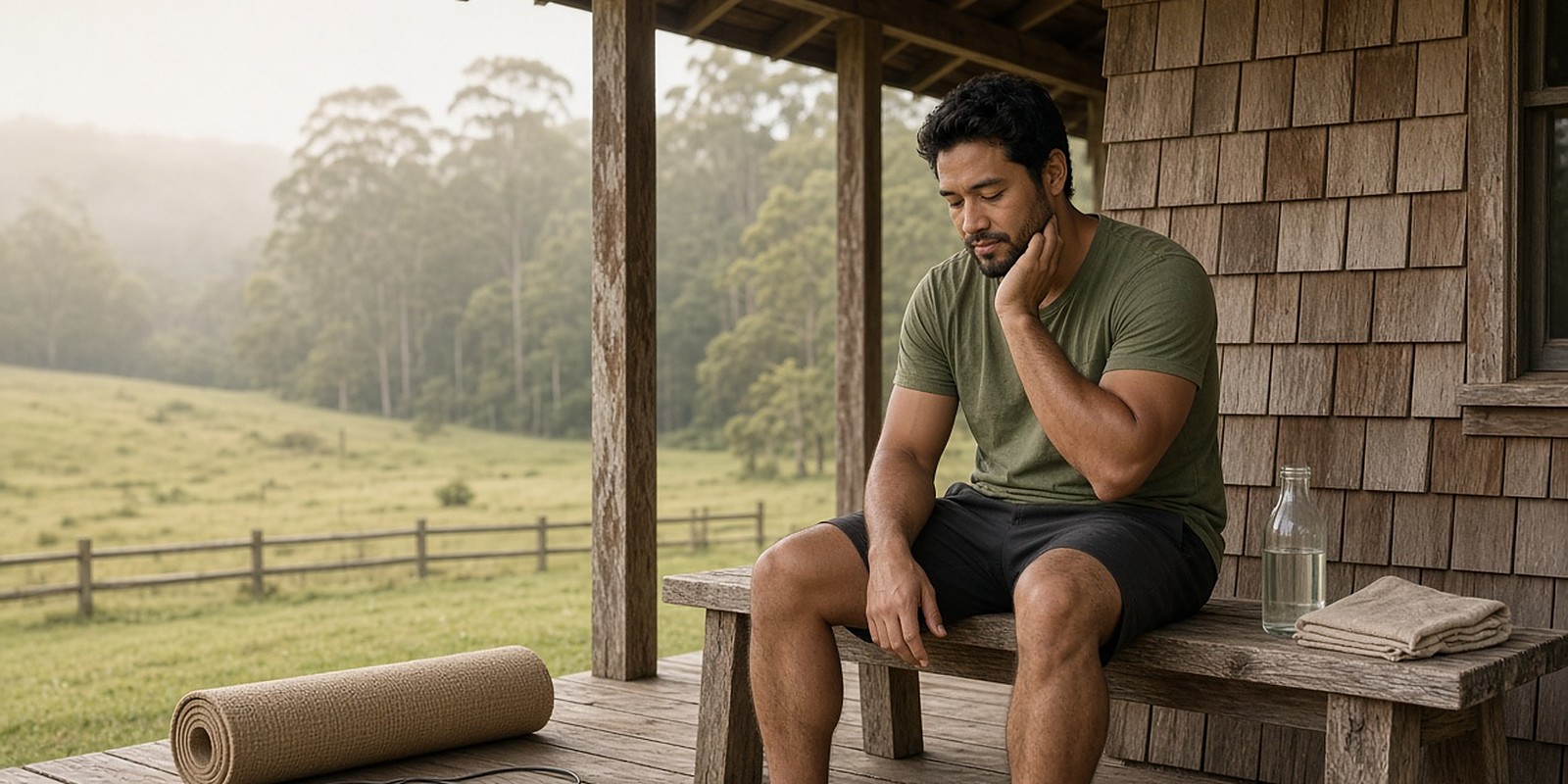
You hit the last rep, the last hill, the last paddle back out, and your teeth are locked together. You did not decide to do that. Later the cheek feels tired, or a dull ache sits at the temple, and you wonder if the workout or the jaw is the problem.
Jaw clenching during exercise is common. Effort and bracing travel together, and the jaw is one of the first places to brace. This guide covers why it happens, where it tends to show up, the signs your jaw is doing more than it needs to, one gentle place to start, and when soreness after a workout is worth getting checked. It is self-care education, not a diagnosis, and it will not cure TMJ, TMD, or teeth grinding.
Educational self-massage only. This is not a substitute for medical or dental care. Stop if pain increases. See a qualified clinician for persistent jaw, ear, or head pain, locking, or anything you cannot explain. Read the medical disclaimer.
In this guide
Why your jaw braces when you work hard
When the body works hard, it braces. The trunk stiffens, the hands grip, and the jaw often closes and holds. It is an old reflex that helps you feel solid under load.
The muscles doing the holding are the same ones you chew with. The masseter sits on the cheek, between the cheekbone and the angle of the jaw. The temporalis fans across the side of the head above the ear. Both are strong and built for short bursts.
Bracing for a moment is not the issue. The trouble is the clench that hangs around: through easy reps, between sets, on the drive home, and into the evening. A muscle that holds for most of an hour starts to feel it, the same way your grip would if you never let go of the bar.
If you already clench at your desk or in traffic, your jaw starts the workout tired. That is often why training days and sore-jaw days line up. Jaw Clenching and Stress covers the everyday side of that habit.
Where it tends to show up
Most people notice it in one or two places, not everywhere.
- Lifting. Heavy sets, the last few reps, and holding a plank or wall sit.
- Running and cycling. Hills, intervals, and the final push, especially when you are watching the clock.
- Paddling and surfing. Long paddles out, duck dives, and holding your breath under a wave.
- Yoga and Pilates. Long holds and balance poses, where the face quietly works as hard as the legs.
- Classes and intervals. Fast work with a timer running and someone counting down.
- Focus moments. Learning a new move, a tricky climb, or concentrating on form.
Pick the one that sounds like you. That is the place to start noticing.
Signs your jaw is doing extra work
You may not catch the clench itself. You will often catch what it leaves behind:
- A tired, achy cheek after a session
- A dull ache at the temple or along the side of the head later in the day
- Teeth that feel pressed or sensitive after a workout
- A tight neck and shoulders that come with a tight face
- Noticing your teeth together when you finally stop moving
None of these mean something is wrong with you. They are clues that the jaw is joining in more than it needs to. If the neck and jaw tighten together for you, Tight Neck and Jaw explains how they connect.
Tired muscle, or something to get checked?
Muscle soreness from clenching usually feels dull, achy, and spread across the cheek or temple. It tends to ease with rest and gentle care, and it does not center on one tooth.
Some jaw symptoms after exercise are not a clenching story. See your dentist if:
- One tooth hurts when you bite, or pain is sharp and in one spot
- Your bite feels different, or teeth no longer meet the way they used to
- Clicking has turned painful, or the jaw catches, locks, or will not open fully
- You notice chipped teeth or new wear
If you took a hit to the face or jaw during sport, get it checked before any self-massage. If your dentist or coach has recommended a mouthguard for your sport or a night guard for sleep, keep wearing it.
Get urgent care for jaw pain that comes with chest pressure, shortness of breath, nausea, or sweating during or after exercise. Do not wait that out. For plain-language background on jaw joint and muscle problems, the NIDCR page on TMD is a calm place to start.
One thing you can do today
After a training session, when the cheek feels tired, the masseter is the natural place to start. It is the muscle doing most of the bracing, and it sits right under your fingertips.
Our starter walks you through it step by step, including how to find the muscle with a gentle clench test and how much pressure to use: How to Massage Your Masseter at Home. Use that one guide, not a mix of videos.
A few reminders for a post-workout jaw:
- Cool down first. Wait until your breathing has settled and you are sitting or standing comfortably.
- Lighter than you think. A tired muscle wants dull, easy pressure. Never sharp.
- Stay off the joint. The small spot just in front of the ear is not where we work.
- Short is fine. A minute or two is plenty. Stop if the ache sharpens.
Hands on the muscle can help it soften. They do not turn off the stress response that keeps re-tightening it. Before you start, take one slow breath.
If the temple aches more than the cheek after a hard session, the temporalis guide is the alternative. Choose one on day one, not both.
Small cues during a workout
You do not have to fight every clench. Some effort will always bring the jaw along. The goal is to stop carrying it into the parts of the workout that do not need it.
- Easy reps, easy face. On warm-ups and lighter sets, let the cheeks stay soft. Save the effort for the muscles you are training.
- Unclench between sets. When you rack the weight or stop the clock, check in. Teeth apart, lips together.
- Watch your focus face. Concentrating on form often brings a set jaw. Notice it once per session, without judging it.
- Use the cooldown. The walk or stretch at the end is a good moment to let the jaw go before you get in the car.
- Check in later. Many people clench hardest on the drive home or back at the screen. A quick check then counts too.
These are reminders, not rules. If you are not sure what a relaxed jaw even feels like, How to Relax Your Jaw Muscles walks through a simple check-in.
Skip-if list
Gentle muscle care suits most people with a tired jaw. Some situations need a clinician first.
Skip self-massage, and see a dentist, PT, or physician instead, if:
Your jaw locks open or closed
You have an acute jaw injury, a hit to the face, bruising, or recent trauma
You have an active infection near the jaw, ear, or teeth, or sores inside the mouth
You have had recent dental work, oral surgery, or extractions that have not fully healed
You notice unexplained swelling, numbness, a new lump, or pain that is getting worse
Get urgent care for a sudden severe headache, facial weakness, vision change, slurred speech, chest pressure, or other symptoms that feel serious. Do not wait those out.
Common questions
Why do I clench my jaw when I work out?
Effort makes the body brace, and the jaw is one of the first places it braces. Most people do it without noticing. It becomes a problem mainly when the clench sticks around after the effort is over.
Is clenching my jaw while lifting bad?
A brief brace on a heavy effort is common. What we pay attention to is clenching through easy sets, between sets, and after the workout. If you have questions about bracing for a specific lift, ask your coach, and ask your dentist about any tooth wear.
Why is my jaw sore after a workout?
Often the chewing muscles held a clench for much of the session. If soreness centers on one tooth, comes with a changed bite, or follows a hit to the face, see your dentist.
Should I wear a mouthguard at the gym?
That is a question for your dentist or coach, especially for contact sports. If one has been recommended for you, keep wearing it. Massage does not replace it.
How do I stop clenching my teeth when I run?
Start by noticing. Check your face on easy stretches of the run, and let your teeth come apart when you catch the clench. Small, repeated check-ins tend to help more than trying to control it the whole way.
Can massage help?
Gentle massage can help a tired chewing muscle feel softer after training. It does not treat TMJ or fix a dental problem, so anything on the dentist list above comes first.
Work with Brooke
Clenching during exercise is often a strong habit in a strong muscle, carried past the moment it was useful. Easy-face reps, unclenching between sets, and the masseter starter are a good place to begin.
Brooke Neborsky, LMT, built Release Your Jaw for people whose jaw works hard even when the rest of them is resting. It brings in the other chewing muscles, intra-oral work with its own safety rules, the breath work that calms the clench cycle, a flare-up plan for bad days, and seven daily routines built for real life. It is $247 once, lifetime access. No equipment. For the bigger picture of which muscles carry jaw tension, see TMJ Self Massage: What Is Safe to Try at Home.
Educational content only. This is not a substitute for medical or dental care. Read the medical disclaimer before you start.