

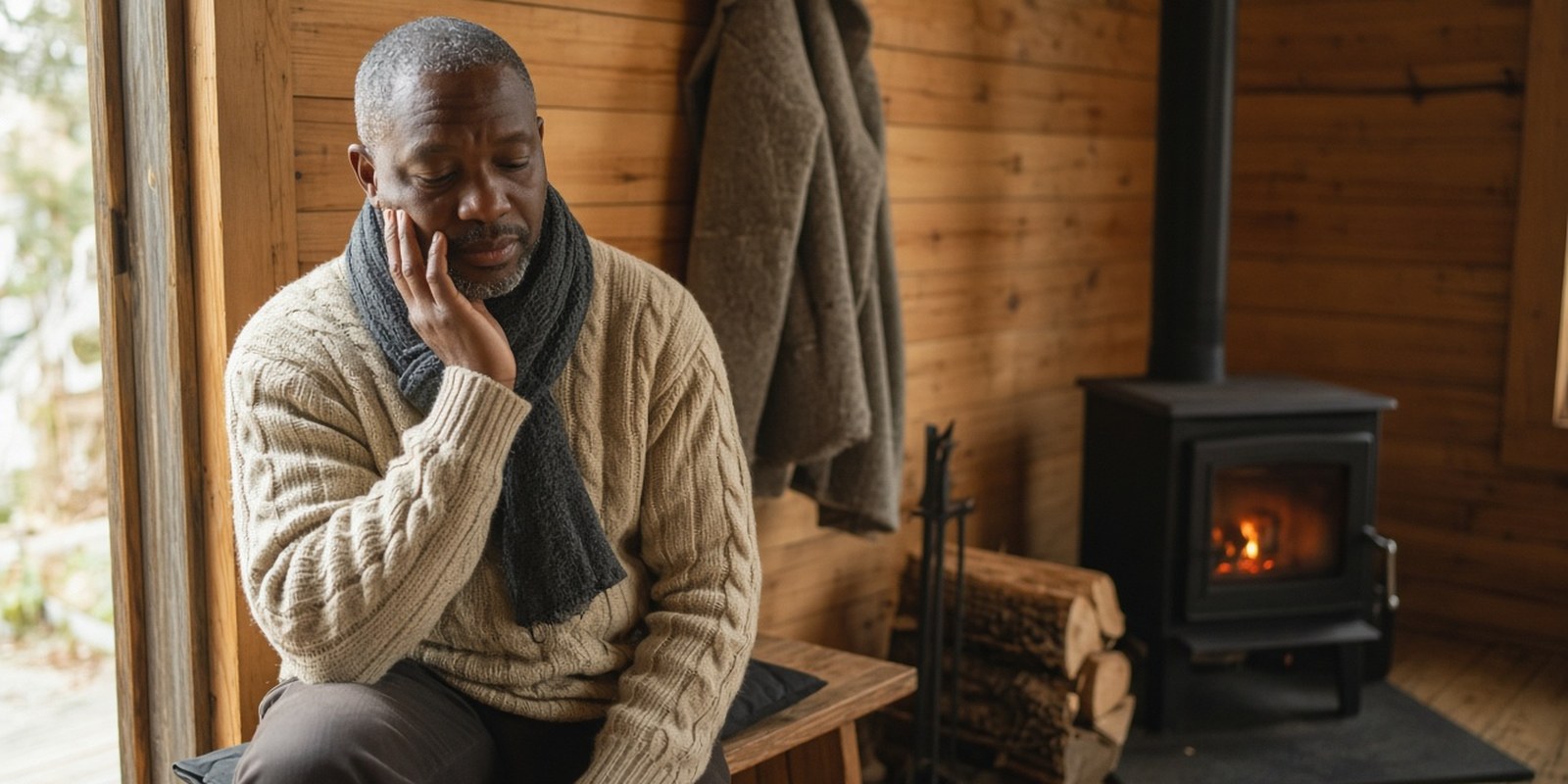
You step outside on a cold morning and, within a few minutes, your jaw is set. Teeth together, shoulders up by your ears, chin tucked into your collar. By the time you get back inside, your cheeks ache and your temples feel tight, and the stiffness hangs around into the evening.
Jaw pain in cold weather is something many people notice once the season turns. Often the cause is simple: the body braces against the cold, and the chewing muscles are part of that brace. Sometimes it is something else, like a tooth that reacts to cold air or sinus pressure, and those need a different kind of help. This guide covers what to check first, why cold makes the jaw grip, gentle habits for chilly days, and one safe place to start. It is self-care education, not a diagnosis.
Educational self-massage only. This is not a substitute for medical or dental care. Stop if pain increases. See a qualified clinician for persistent jaw, ear, tooth, or head pain, locking, numbness, swelling, or anything you cannot explain. Read the medical disclaimer.
In this guide
Check this first: when to get help
Most cold-day jaw stiffness is muscle tension. A few patterns are not, and they come before any massage.
Call emergency services right away if jaw pain comes with chest pressure, shortness of breath, a cold sweat, nausea, or pain spreading to the arm, neck, or back. This matters in winter in particular, because cold air and effort, like shoveling or walking fast uphill, can bring on heart symptoms that show up in the jaw. That pattern needs emergency care, not self-massage.
Call your dentist or doctor the same day if your jaw gets stuck open or closed, or you cannot open enough to eat or brush. Do not force it, and do not try to massage it free.
See your dentist, doctor, or a TMJ specialist soon if:
- A tooth zings or aches sharply when cold air or cold drinks touch it
- You get brief, electric, shock-like pain in the face when wind or cold hits your skin
- Pain sits under the eyes or across the upper teeth with a stuffy nose, a cold, or pressure when you bend forward
- Your jaw has started to catch, click with pain, or open less than before
- Your bite feels different, or one side of the face is swollen
- You have ear pain, fever, or pain that keeps getting worse
A dentist can check for sensitive or cracked teeth, and a doctor can look at sinus or nerve causes. If you already wear a night guard, keep wearing it. For plain-language background on jaw muscle and joint problems, the NIDCR page on TMD is a good place to start.
Why cold weather can make your jaw ache
Each side of your jaw has strong closing muscles. The masseter sits on the cheek, between the cheekbone and the angle of the jaw. The temporalis fans across the side of the head above the ear. Their job is to bring the teeth together and hold them there.
When you get cold, your body tightens up to hold in warmth. Shoulders lift, the neck shortens, hands go into pockets, and the jaw often clamps shut. Some people’s teeth chatter, which is the jaw muscles firing over and over. Even without chattering, many of us hold the teeth together on a cold walk without noticing.
That grip adds up. A commute, a dog walk, a school run, and an hour in a drafty room can mean a lot of clenching in one day. If you already clench when stressed or grind at night, cold days give that habit one more reason to switch on. The muscles then feel tender and slow to let go.
There is also the season itself. Shorter days, holiday plans, and more time hunched over screens indoors can all keep the jaw and neck working. Our post on jaw clenching and stress covers that wider pattern.
The jaw joint sits just in front of the ear. Pain right at that spot, catching, or a painful click belongs on the check-first list above, not in a massage plan. Jaw Clicking and Popping covers what is safe to notice.
Muscle ache or something else?
It helps to know what tired chewing muscles usually feel like, so you can tell when something does not fit.
Cold-day muscle tension tends to:
- Feel like a broad, dull ache in the cheeks or temples, often on both sides
- Build during or after time out in the cold, then ease slowly once you warm up
- Feel tender when you press the cheek gently
- Come with tight shoulders and a stiff neck
- Make the first bites of a meal feel stiff
Things that point somewhere else:
- Sharp pain in one tooth with cold air or cold drinks
- Pain mostly under the eyes with congestion
- Sudden, stabbing, shock-like pain that lasts seconds
- Pain with fever, swelling, or a bite that has changed
Muscle tension is where gentle self-care can help. The second list belongs with your dentist or doctor.
Gentle habits for cold days
You do not need to work hard on your jaw in winter. Lowering how much it grips is usually the bigger win.
- Cover your face and neck. A scarf or high collar over the jaw and neck means less reason to brace.
- Teeth-apart check-ins. When you notice you are cold, check your jaw. Aim for teeth apart, lips soft, tongue resting easy.
- Drop your shoulders. Raised shoulders and a clamped jaw tend to travel together. Let the shoulders settle when you get inside.
- Warm up before you work. Give your face and hands a few minutes indoors before you start any self-massage.
- Keep the range comfortable. Skip forced stretches and any attempt to crack or pop the joint.
These are awareness cues, not a course routine, and not breath drills or joint work. If the neck is part of your winter stiffness, Tight Neck and Jaw explains how the two connect.
One thing you can do today
If the ache feels like tired cheeks after time in the cold, the masseter is the natural place to start. It does most of the clamping, and it sits right under your fingertips on the outside of your face.
Our starter walks you through it step by step, including how to find the muscle with a gentle clench test and how much pressure to use: How to Massage Your Masseter at Home. Use that one guide, not a mix of videos.
A few reminders for cold days:
- Warm first. Come inside, take off your coat, and let your face warm up for a few minutes.
- Outside the mouth only. Hands stay on the cheek.
- Dull, easy pressure. Never sharp, and never pushing through it.
- Not on a sore tooth. If one area hurts sharply, leave that side and check with your dentist.
- Stay off the joint. The small spot just in front of the ear is not where we work.
- Short is fine. A minute or two on each side is plenty. Stop if the ache sharpens or spreads.
Hands on the muscle can help it soften. They do not turn off the stress response that keeps re-tightening it. Before you start, take one slow breath.
What softens more slowly
One masseter session is a start. Winter lasts months, and a jaw that has learned to brace every time you step outside may keep doing it. Other chewing muscles may be part of the grip, the neck and shoulders often join in, and the nervous system may still be set to clench on busy, dark days.
Release Your Jaw goes further without turning this page into a second course: other chewing muscles, intra-oral work with its own hygiene and stop rules, breath and nervous-system pieces, a flare-up plan, and seven short routines. None of that is taught here. If you wake with a tired jaw on cold mornings, Jaw Pain in the Morning covers that pattern.
Skip-if list
Gentle muscle care suits many people with cold-day jaw tension. Some situations need a clinician first.
Skip self-massage if:
You have swelling, a bad taste, fever, or signs of infection near the jaw, ear, or teeth
A tooth hurts sharply, or your bite suddenly feels very different
You recently had an extraction, implant, or other oral surgery and have not been cleared for touch on the face
Your jaw is stuck open or closed, or has locked recently
You have shock-like facial pain, unexplained numbness, a new lump, or pain that keeps getting worse
If anything on the emergency list at the top of this page applies, that needs care now, not massage.
Common questions
Why does my jaw hurt when it is cold?
Often because the body braces against the cold and the jaw clamps shut as part of that brace. Teeth chattering works the same muscles too. Sharp tooth pain, sinus pressure, or shock-like facial pain point to other causes and need a dentist or doctor.
Can cold weather make TMJ symptoms worse?
Many people notice more jaw stiffness and tenderness in cold months, likely from bracing and tension. If your jaw is catching, locking, or clicking with pain, see your dentist or a TMJ specialist.
Is it normal for my teeth to hurt in cold air?
Sharp, zinging pain when cold air hits a tooth is often tooth sensitivity, which is a dental question. Ask your dentist rather than treating it as a jaw muscle problem.
Should I use heat on my jaw in winter?
Many people find gentle warmth comfortable, like a warm hand or a warm cloth over the cheek. Keep it comfortable, not hot, and skip it if there is swelling or signs of infection.
Can I massage my jaw right after coming in from the cold?
Give yourself a few minutes to warm up first. Then gentle work on the outside of the cheek is a reasonable place to start. Stay off the joint and skip any side where a tooth is sharply sore.
Should I stretch my jaw open to loosen it?
No. Forced stretches and trying to pop the joint are not the place to start. Stay in a comfortable range and let the muscles settle.
Work with Brooke
Jaw pain in cold weather is often a jaw that braces along with the rest of the body. Cover up, notice when you clamp down, rule out tooth, sinus, and nerve causes with your clinician, and start with the masseter starter.
Brooke Neborsky, LMT, built Release Your Jaw for people who want guided jaw care at home without guessing. It brings in the other chewing muscles, intra-oral work with its own safety rules, breath and nervous-system pieces, a flare-up plan, and seven daily routines. It is $247 once, lifetime access. No equipment.
Brooke Neborsky, LMT
Brooke Neborsky, LMT, built Release Your Jaw for people who want guided work, not more guessing. It is $247 once, lifetime access.
Educational content only. This is not a substitute for medical or dental care. Read the medical disclaimer before you start.